Copper remains one of Canada’s most important strategic minerals in 2026, powering everything from electric vehicles and grid upgrades to data centres supporting AI growth. The federal government now classifies major copper projects as “nation-building infrastructure,” placing them alongside renewable energy and transmission lines.
In this landscape, Copper Road Resources Inc. is advancing exploration north of Sault Ste. Marie, targeting porphyry-style systems in the historic Tribag Mine district. Their work sits within a broader surge of copper development across British Columbia, Ontario, Saskatchewan, and Atlantic Canada.
About Copper Road
| Key Facts | Details |
|---|---|
| Company | Copper Road Resources Inc. (TSXV: CRD) |
| Location | Batchewana Bay District, near Sault Ste. Marie, Ontario |
| Historic site | Tribag Mine (1960s–70s production) |
| Land package | 21,000 hectares |
| Stage | Exploration |
| Target | Porphyry-style copper systems |
| Support | Marrelli Support Services Inc. |
The Copper Road Project spans over 21,000 hectares in Northern Ontario’s Batchewana Bay district. The land package includes several zones of interest, anchored by the past-producing Tribag Mine. While copper hasn’t been mined here for decades, new surveys and drill programs are targeting porphyry-style systems that could support large-scale operations if proven economically.
Management
Copper Road Resources is managed by a team with experience in Canadian mining finance and exploration. The company is supported by Marrelli Support Services Inc., which handles compliance and reporting for junior miners. For a project still in exploration, that structure provides both credibility and oversight.
Project Zones
The property hosts several mineralized areas, with two zones receiving the most attention today.
JR Zone
The JR Zone, located in the northern part of the property, has been outlined through geophysical work and drilling. Early results show copper-bearing mineralization consistent with porphyry systems. Additional drilling is planned to test continuity and scale.
Tribag Zone
Centred on the historic Tribag Mine, this zone produced copper in the 1960s and 70s from breccia pipes and porphyry-style systems. Copper Road is applying modern exploration techniques to test extensions of that mineralization and identify new targets. If results confirm scale, the Tribag Zone could revive copper production in Ontario.
Other Major Copper Projects in Canada
Beyond Copper Road, most of Canada’s output comes from large mines in British Columbia, with contributions from Ontario, Manitoba, Saskatchewan, and New Brunswick. Here are the key projects active in 2025.
- Highland Valley Copper (Teck, B.C.)
- Gibraltar Mine (Taseko, B.C.)
- Copper Mountain (Hudbay, B.C.)
- Mount Milligan (Centerra, B.C.)
- Kidd Creek (Glencore, Ontario)
- Red Chris Expansion (Imperial Metals/Newcrest, B.C.)
- McIlvenna Bay (Foran, Saskatchewan)
- Murray Brook (Canadian Copper, New Brunswick)
- NorthWest Copper’s projects (B.C.)
Highland Valley Copper – Teck, B.C.
| Key Facts | Details |
|---|---|
| Owner | Teck Resources |
| Province | British Columbia |
| 2026 output | 132k tonnes |
| Mine type | Open-pit |
| Mine life | Extended to 2046 |
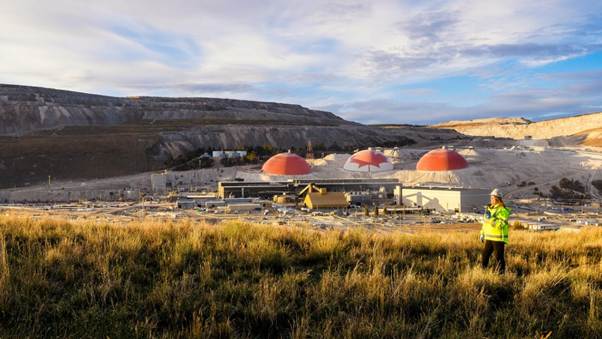
Highland Valley remains the anchor of Canada’s copper output, and its role strengthened further in 2025 as a fully funded $2.1–$2.4 billion expansion moved into active construction. The mine is now expected to maintain production levels of about 132,000 tonnes per year, up from earlier estimates of 114,000 tonnes, and the approved extension secures operations through 2046.
Often described locally as “the mine that built communities,” Highland Valley continues to stand out not only for its scale and long-term stability but also for Teck’s ongoing investments in workplace mental health programs – a rare but needed angle in heavy industry.Highland Valley remains the anchor of Canada’s copper output. In 2024, it produced around 114,000 tonnes, and recent approvals extended its mine life to 2046. Often described locally as “the mine that built communities,” it also stands out for Teck’s investments in workplace mental health programs – a rare but needed angle in heavy industry.
Gibraltar Mine – Taseko, B.C.
| Key Facts | Details |
|---|---|
| Owner | Taseko Mines Ltd. |
| Province | British Columbia |
| 2024 output | 52k tonnes |
| Mine type | Open-pit |
| Mine life | Until 2044 |
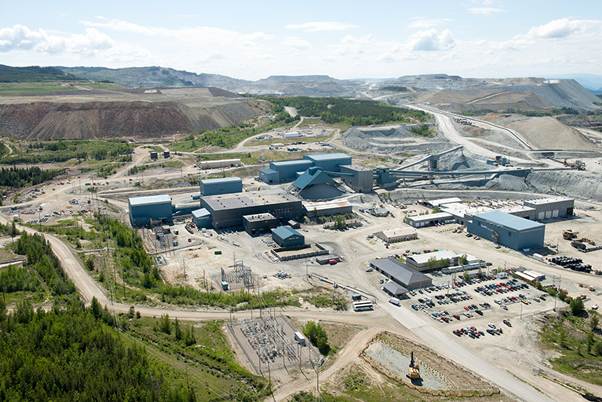
Taseko’s Gibraltar Mine is Canada’s second-largest open-pit copper operation, producing about 52,000 tonnes of copper in 2024, with a life-of-mine average of roughly 59,000 tonnes per year. The mine remains the largest employer in the Cariboo region and has operated continuously since Taseko’s $700 million restart in 2004.
A 2025 economic impact study confirms that Gibraltar will continue supporting copper and molybdenum production until at least 2044, reinforcing its role as one of Canada’s key long-life copper assets.Taseko’s Gibraltar Mine is Canada’s second-largest open-pit copper operation, producing about 52,000 tonnes in 2024. The mine is a major employer in the Cariboo region and has been in continuous operation since a $700 million restart in 2004, making it one of the country’s key long-life copper assets.
Copper Mountain – Hudbay, B.C.
| Key Facts | Details |
|---|---|
| Owner | Hudbay Minerals |
| Province | British Columbia |
| 202 output | 40k tonnes |
| Mine type | Open-pit |
| Mine life | Until 2054 |
Hudbay’s 2023 acquisition of Copper Mountain made it the third-largest copper company in Canada, and in 2025 it moved to full ownership by buying Mitsubishi Materials’ remaining 25% stake. The mine produced roughly 40,000 tonnes last year, and Hudbay’s updated life-of-mine plan targets average copper output of about 46,500 tonnes per year over the next five years and 45,000 tonnes per year over the following decade.
With an expected mine life out to around 2043 and growth potential from the New Ingerbelle expansion, Copper Mountain has a solid runway to become a generational asset if copper demand stays strong.Hudbay’s 2023 acquisition of Copper Mountain made it the third-largest copper company in Canada. The mine produced roughly 40,000 tonnes last year, with gold and silver credits sweetening margins. Its long runway (out to 2054) means it could become a generational project, provided copper demand stays strong.
Mount Milligan – Centerra, B.C.
| Key Facts | Details |
|---|---|
| Owner | Centerra Gold |
| Province | British Columbia |
| 2025 output | 24.5k tonnes |
| Mine type | Open-pit copper-gold |
| Mine life | Until 2045 |
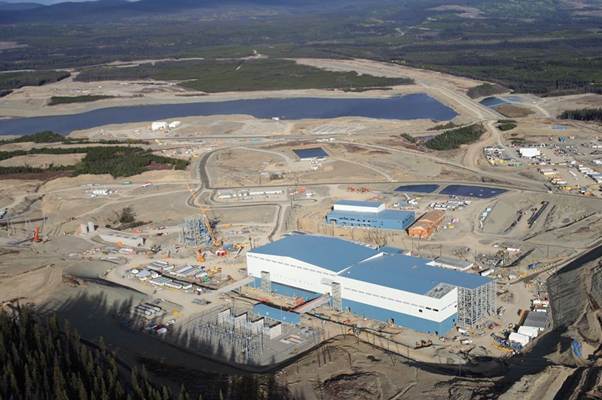
Mount Milligan, located south of Mackenzie, B.C., produced about 54 million pounds of copper (roughly 24,500 tonnes) and 168,000 ounces of gold in 2024, reflecting its strong copper-gold balance. A new 2025 Pre-Feasibility Study extended the mine life from 2033 to 2045, driven by expanded reserves and planned upgrades that will lift plant throughput to 66,300 tonnes per day by 2029.
With 4.4 million ounces of gold and 1.7 billion pounds of copper now in proven and probable reserves, Mount Milligan remains a major long-life asset for Centerra, offering stable output, strong cash flow, and a natural hedge from its gold creditsMount Milligan, located south of Mackenzie, B.C., produced nearly 30,000 tonnes of copper in 2024. The mine is notable for its copper-gold balance, with gold revenues exceeding copper revenues in 2024, providing a natural hedge against commodity price volatility..
Kidd Creek – Glencore, Ontario
| Key Facts | Details |
|---|---|
| Owner | Glencore Plc |
| Province | Ontario (Timmins) |
| 2024 output | 27k tonnes |
| Mine type | Underground |
| Mine life | Production to end of 2026 |
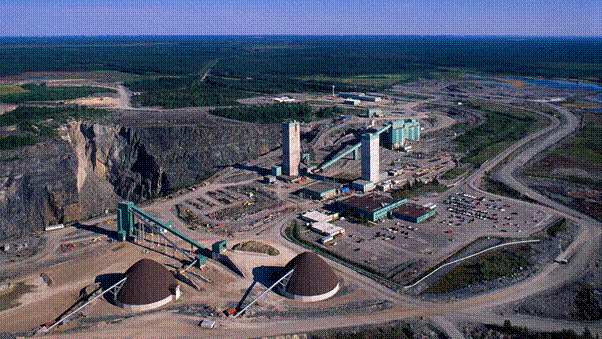
Kidd Creek, located near Timmins, Ontario, is the world’s deepest base-metal mine, with workings nearly three kilometres underground and a shaft bottom around 9,900 feet. It typically produces about 40,000 tonnes of copper and 70,000 tonnes of zinc per year, making it a major long-term contributor to the local economy. Glencore has now confirmed that mining will cease at the end of 2026, with reclamation work beginning in 2027.
Red Chris Expansion – B.C.
| Key Facts | Details |
|---|---|
| Owner | Newmont (70%) / Imperial Metals (30%) |
| Province | British Columbia |
| Stage | Expansion |
| Expected impact | +15% to B.C.’s copper exports |
| Indigenous partner | Tahltan Nation |
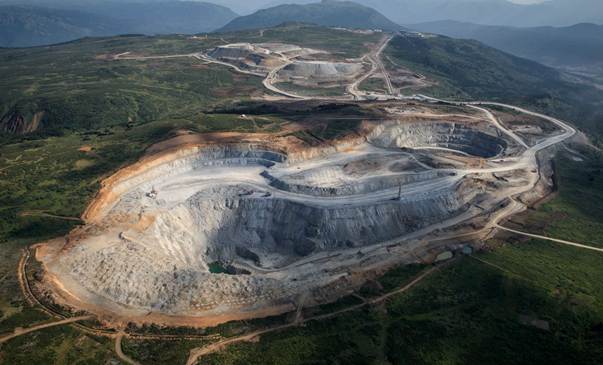
Red Chris is now operated by Newmont in partnership with Imperial Metals, and its planned underground expansion has been identified by Prime Minister Mark Carney as one of Canada’s top “nation-building” projects for 2025.
The project, located on Tahltan Nation land, would shift Red Chris from an open-pit mine to a long-life block-cave operation, extending its lifespan by more than a decade and unlocking a $2-billion investment that includes about 1,800 construction jobs and 1,500 ongoing positions.
Provincial filings suggest the expansion could raise British Columbia’s copper exports by roughly 15%, and both the Tahltan Nation and the B.C. Environmental Assessment Office are expected to review a final decision on the project by the end of 2025.
McIlvenna Bay – Foran, Saskatchewan
| Key Facts | Details |
|---|---|
| Owner | Foran Mining Corporation |
| Province | Saskatchewan |
| Reserves | 29.7 Mt (probable) |
| Metals | Copper, Zinc, Gold, Silver |
| Stage | Development (2025 NI 43-101) |
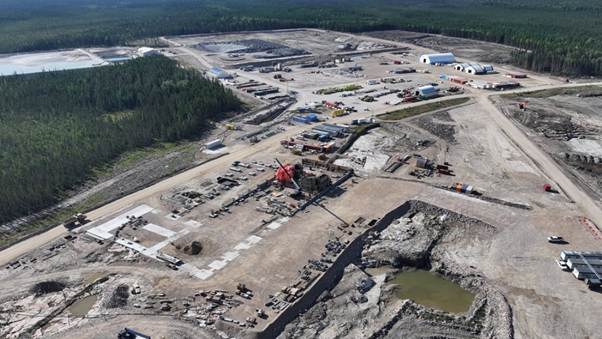
McIlvenna Bay sits along the Flin Flon Greenstone Belt and is now described as the largest undeveloped polymetallic deposit in the region, with a 2025 NI 43-101 confirming 29.7 million tonnes of probable reserves containing 793 million pounds of copper and 1.4 billion pounds of zinc.
The project is designed as Canada’s first net-zero copper-zinc mine, using hydroelectric power, underground electric vehicle fleets, and a modern paste-backfill and tailings system to cut emissions. Foran also maintains a long-running relationship with the Peter Ballantyne Cree Nation, adding community partnership to a project already recognized for its clean-tech design and scalable resource potential.
Murray Brook & Murray Brook West – New Brunswick
| Key Facts | Details |
|---|---|
| Owner | Canadian Copper |
| Province | New Brunswick |
| Stage | Advanced exploration |
| Synergy | Caribou Complex acquisition |
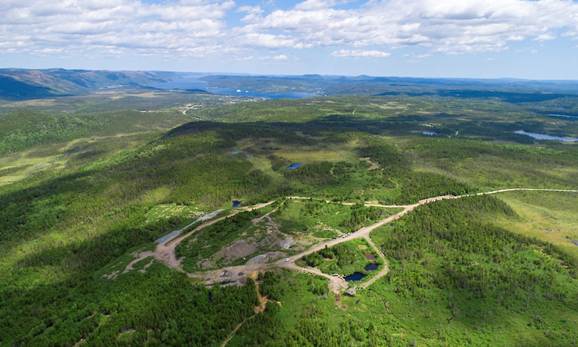
Canadian Copper, supported by Marrelli Support Services Inc., now controls 100% of the Murray Brook Deposit, the largest undeveloped VMS resource in New Brunswick with more than 21 million tonnes outlined in its 2023 mineral estimate.
Designed as a future open-pit operation and already through pre-development stripping, Murray Brook offers strong district potential along the Caribou Horizon trend. Adjacent to it, the 2,790-hectare Murray Brook West property covers seven kilometres of the same prospective ore horizon and remains highly underexplored, with geochemical anomalies, mapping programs, and new drill targets planned for 2025.
NorthWest Copper Projects – B.C.
| Key Facts | Details |
|---|---|
| Owner | NorthWest Copper |
| Province | British Columbia |
| Land position | 175,000+ hectares of Cu–Au tenure |
| Key projects | Kwanika-Stardust, Lorraine-Top Cat, East Niv |
| Stage | Advanced exploration & PEA-stage development |
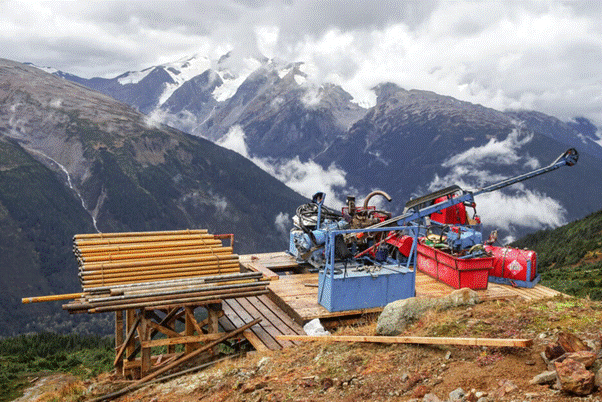
NorthWest Copper holds over 175,000 hectares of copper-gold projects in north-central B.C., positioned between Mount Milligan and the former Kemess mine. Its main asset is the 100% owned Kwanika–Stardust project, supported by a positive 2023 PEA and a 2025 drill program targeting higher-grade zones.
To the north, Lorraine–Top Cat carries a 2022 NI 43-101 resource and multiple Cu-Au targets, while East Niv is a 2021 porphyry discovery south of Kemess. With all projects close to road and power, the company is assessing whether Kwanika–Stardust and Lorraine–Top Cat could form a future hub-and-spoke development.
What is Copper Used For?
Copper is essential for the modern economy. You’ll find it in:
- Wiring, plumbing, and construction
- Electric vehicles, wind farms, and solar panels
- AI and data centres powering cloud services
- Antimicrobial applications in hospitals and healthcare
Why Even Online Gambling Depends on Copper
At first glance, casinos and copper don’t mix. But dig deeper, and the link becomes obvious. Slot machines and VLTs rely on copper wiring in their circuits. Casino resorts are effectively micro-cities, consuming huge amounts of copper for lighting, HVAC, and surveillance systems.
On the digital side, online casinos depend on data centres: every server rack and payment switchboard runs through copper wiring. Interac payments, which we tested across several iGaming platforms this year, rely on secure copper-based hardware. Even “green casinos,” which install solar panels or wind turbines, need copper to connect renewable energy sources.
When comparing the best Canadian online casino sites, this guide to how top-rated platforms actually earn user trust and stay technically resilient sheds light on factors most people overlook – from backend stability to payment flow efficiency.
And for readers who want an even clearer sense of the safest online casinos in Canada, you can review this expert-backed explainer, which outlines how secure platforms function and what protections are available to Canadian players.
Here’s what the page includes:
| Feature | Details |
|---|---|
| 🔐 Security | Platforms are reviewed for encryption standards and data protection. |
| 💸 Payments | Interac, credit cards, and e-wallets tested for speed and uptime. |
| 🎲 User Experience | Site speed, mobile compatibility, and live dealer features covered. |
| 📍 Canadian Focus | Only legal and licensed platforms available to Canadian players. |
| 🧾 Transparency | Full breakdown of terms, payout rates, and customer support. |
In other words, whether it’s a roulette wheel in Vegas or an online slot in Ontario, the gambling industry literally runs on copper – and knowing which platforms are built on stable, secure systems is just as important as picking the right game.
6 Facts About Copper Mining in Canada
- Canada produced 508,000 tonnes of copper in 2024 (NRCan).
- B.C. accounts for nearly half of Canadian output.
- Canada ranks 12th globally, with about 2.2% of supply.
- Exports were valued at $9.4B in 2024, mainly to the U.S., China, and Japan.
- Ottawa launched the Major Projects Office in 2025 to fast-track copper and other critical minerals.
- Despite nearly 900M tonnes of reserves, Canada holds less than 1% of the world’s total.
Where is Copper Found in Canada?
Copper production in Canada is concentrated in a few regions. British Columbia leads by a wide margin, delivering nearly half of national output in 2024 with over 235,000 tonnes from Highland Valley, Gibraltar, Copper Mountain, and Red Chris.
Ontario has long been part of the story through the Sudbury basin and Kidd Creek near Timmins, which produced 27,000 tonnes in 2024 but will close at the end of 2026. New exploration, including the Copper Road Project near Sault Ste. Marie, keeps the province in play.
Manitoba contributes through Hudbay’s Lalor Mine in the Snow Lake region, averaging about 20,000 tonnes of copper annually alongside zinc and gold.
Saskatchewan is emerging with the McIlvenna Bay development, designed as Canada’s first net-zero copper project and projected to produce around 30,000 tonnes a year once built.
New Brunswick adds future potential through the Murray Brook deposit in the Bathurst camp, where Canadian Copper has outlined a resource of more than 21 million tonnes.
Top 5 Copper Mines in Canada
These five mines alone account for more than half of the country’s annual production, making them the backbone of Canada’s role in the global copper supply chain.
| Rank | Mine | Province | 2024 Production (GlobalData) |
|---|---|---|---|
| 1 | Highland Valley Copper | B.C. | 132k tonnes |
| 2 | Gibraltar Mine | B.C. | 52k tonnes |
| 3 | Copper Mountain | B.C. | 40k tonnes |
| 4 | Mount Milligan | B.C. | 29k tonnes |
| 5 | Kidd Creek | Ontario | 27k tonnes |
“Canada will never produce as much copper as Chile or Peru, but its industry matters for other reasons. The country is seen as a safe and dependable supplier of critical minerals. From big operations like Teck’s Highland Valley in British Columbia to smaller players such as Copper Road Resources in Ontario, Canada’s copper sector includes both established mines and new exploration.
In 2025, the story is about more than the metal. Copper brings steady jobs to mining towns, supports partnerships with Indigenous communities, drives low-carbon technology, and even powers the wiring behind online payments and gaming. It’s become a quiet backbone of Canada’s future – and its role is only growing.”